SASHAPASHA (Sasha Rotts, Pavel Rotts) in collaboration with curator Sona Stepanyan
Lucid Plexus
Lucid Plexus is a study of forms of historical memory through the lens of collective remembrance, personal testimony, and intergenerational narrative. Anchored in the experience of the Ingrian Finns — an ethnic minority inhabiting Russian territories since the 17th century — it traces a lineage shaped by displacement, captivity, war, and systemic scarcity.
At its core, the project poses a fundamental question: how do we live with memory today? Should it be safeguarded in its static form, or allowed to weave itself into the living fabric of the now — unfolding and vital, a form of evolving knowledge? The work proposes memory not as a sealed archive but as a dynamic, embodied knowledge — restless, intimate, and active.
Turning toward marginal and suppressed histories, Lucid Plexus approaches everyday objects as vessels of memory — silent witnesses to personal and collective experience. Here, art and artistic practice do not serve merely as instruments of preservation or musealization, but rather as means of attentive encounter with the past — acts of reactivation that illuminate obscured narratives into presence.
In resistance to official narratives and their mechanisms of erasure, the project seeks to construct spaces where memory can remain unfinished, alive, and in motion.
Lucid Plexus adopts slow modes of movement as its core methodology — cycling expeditions, walking routes, and situated fieldwork woven through the Nordic-Baltic region, a landscape carrying the memory of a wandering fate of those fleeing WWII, post-war repressions, persecution, deportation, persecution, deportation and labour camps. These practices are not merely logistical, but epistemological: a way of thinking through terrain, of tracing memory with the body.
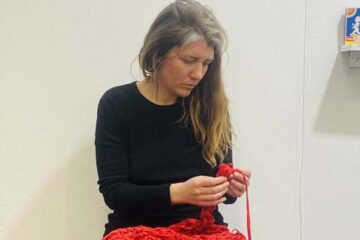
Stitching emerges both as a metaphor and as a method. From embroidery to rock climbing, artists engage in acts of binding, mending, and holding — gestures that echo across scales, from the intimate to the topographical. Walking and stitching become twin forms of cartography and embodiment: ways of mapping through presence, of inhabiting histories through somatic experience.
Manual, tactile practices — carving, embroidery, mold-making — also serve as tools of engagement. These acts slow time, draw attention, and reorient perception from the visual toward the haptic — from the image to the touch.
Routes are composed in relation to sites layered with historical residue: former camps, partisan trails, military fortifications, and refugee encampments along the Baltic coast. These are not simply destinations, but active participants in the project’s unfolding logic of return, reweaving, and reactivation.
Sasha Rotts, patchwork and embroidery on the second-hand towels from Öland island, 2025
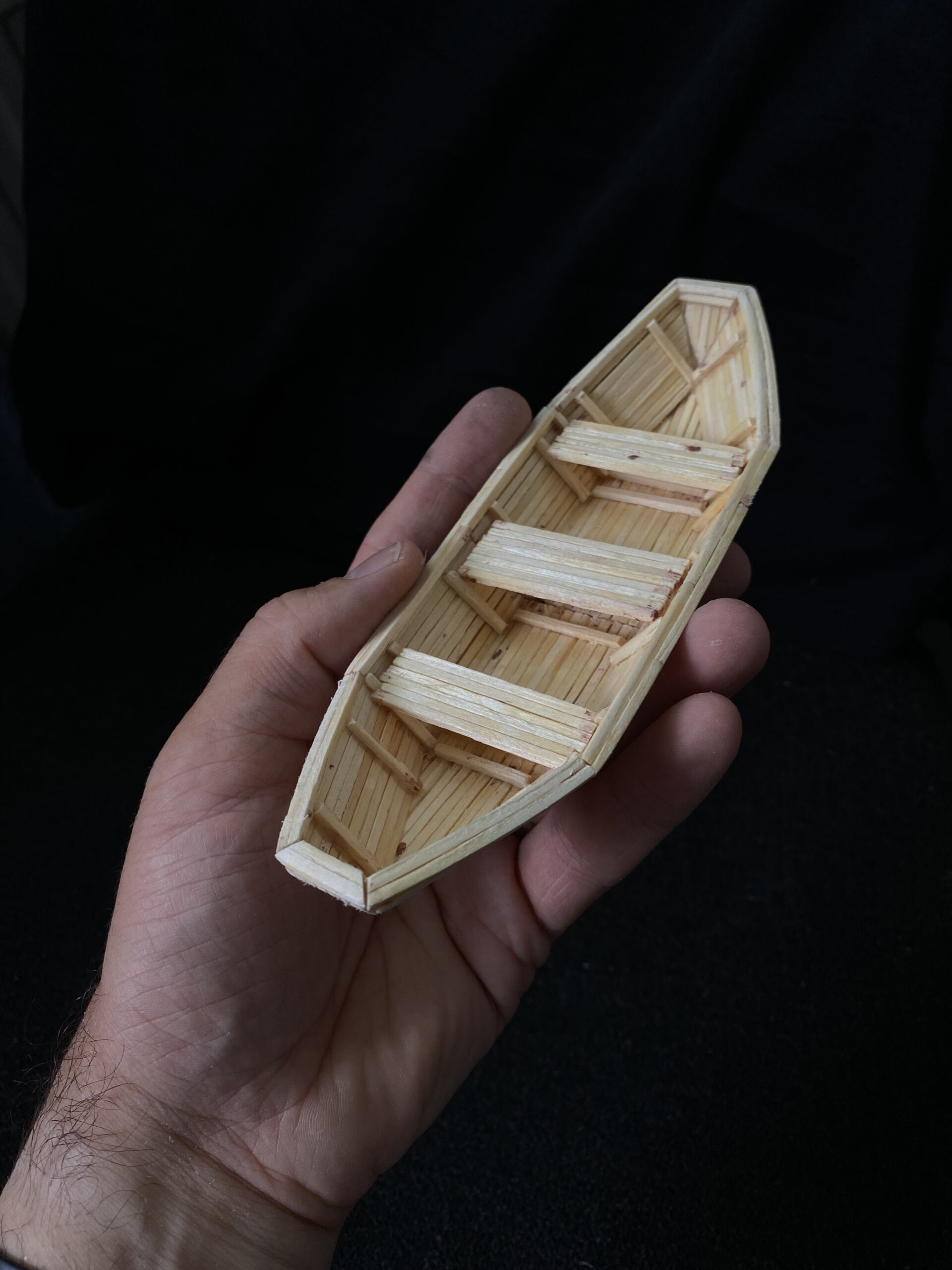
Pavel Rotts, Drift, 2024
A model of the fishermen boat made from matches. On similar boats, about 5000 Ingrans were secretly smuggled to Sweden to avoid deportation to Russia.
*****
Ingrian Finns who were doomed to be deported to the USSR at the end of WWII were escaping to Sweden by any means. Pavel’s ingrian family didn’t avoid the deportation, but some of their relatives reached the Sweden shore illegally, smuggled on the fisherman boats. Swedish-Ingrian writer Ania Monahof shares a similar tale of escaping. Her family sailed from Finland to Sweden but was caught in a storm and washed ashore. They realized they had safely reached Sweden only when they found a box of Swedish matches.
During her childhood, Ania Monahof fled famine and oppression in the Soviet Union, travelling through Estonia and Finland, and arrived in Sweden by fishing boat in 1945. In the autobiographical trilogy, she describes their journey and arrival in Sweden:
“Verner curiously approach the house. Suddenly, they come running and show a matchbox with a small naked child on it. The Finnish woman tore the box from Filipok’s hand and shouted — It’s Swedish! It’s Swedish! We are in Sweden!”.
SASHAPASHA is a Helsinki-based artist duo founded in 2009 by interdisciplinary artists Sasha Rotts and Pavel Rotts. Their collaborative practice focuses on long-term, research-based projects that intersect and expand upon their individual artistic interests and methods.
Sona Stepanyan (b. 1987, Armenia) is a Stockholm-based curator, currently employed at Avesta konsthall as a guest curator for Avesta Art 2026. Her international curatorial practice has consistently been manifesting and centering artistic practices and context-driven thinking through research, exhibitions, and public programming.
Stepanyan’s previous institutional work includes Mint Konsthall (Stockholm), Armenia Art Foundation (Yerevan), and Garage Museum of Contemporary Art (Moscow). Independently, Stepanyan has been involved in jurying, guest curating, and consulting for international stipends, awards, and ongoing programs, including for Södertälje konsthall (2026), Havremagasinet (2025), Saastamoinen Foundation (2024), Stroom Den Haag (2020), Armenia Arts Council, viennacontemporary (2018), Han Nefkens Foundation (2020), and others.