Gabriella Novak, Sweden/Polen
I am a Polish-Swedish artist based in Stockholm with an interdisciplinary practice in which photography, text, and other visual expressions interact. I work with photography, painting, drawing, performance, and video, allowing the medium that best responds to the current investigation to guide the process.
Photographic observations often serve as a point of departure and are further developed through drawing and painting, while performance and text function as reflective and immersive spaces for storytelling. My practice is rooted in autobiography and documentary approaches, revolving around questions of memory, identity, and embodied experience.
In recent years, text has become an integrated and parallel tool in my artistic practice, both as a method and as a primary form. This has led to an in-depth engagement with an autobiographical prose book, in which I explore how visual perception can be translated into literary language.
In this project, I investigate how memories, documentary material, and personal experiences can be woven together into a cohesive prose text. The book will also include newly created drawings as an integrated part of the artistic expression, where text and image interact and shift one another’s meanings.
By starting from the autobiographical, I aim to open up broader questions concerning time, the body, and memory. My practice is characterized by a long-term investigation into how personal experiences can be processed and articulated through different forms of storytelling, which in this project is further developed within a literary format.
Webpage: http://gabriellanovak.com
Email: gabriellanovak@icloud.com
”Water”, Polaroids, 2014
I immerse my face in water as an act of quiet surrender. For a fleeting moment, the body dissolves beneath the surface, suspended between breath and silence, visibility and disappearance.
Water becomes a space of ritual—a gesture of purification and renewal. Submersion marks a threshold, a passage through which the body sheds its weight, memory, and the traces of lived experience. To emerge is not simply to return, but to return altered.
The Polaroid holds this fragile moment of transition. Its singular, material presence mirrors the irreversibility of the gesture itself: an instant that cannot be repeated, only witnessed. The image does not document an action as much as it preserves a state of becoming—a body suspended between dissolution and reappearance, between vulnerability and transformation.
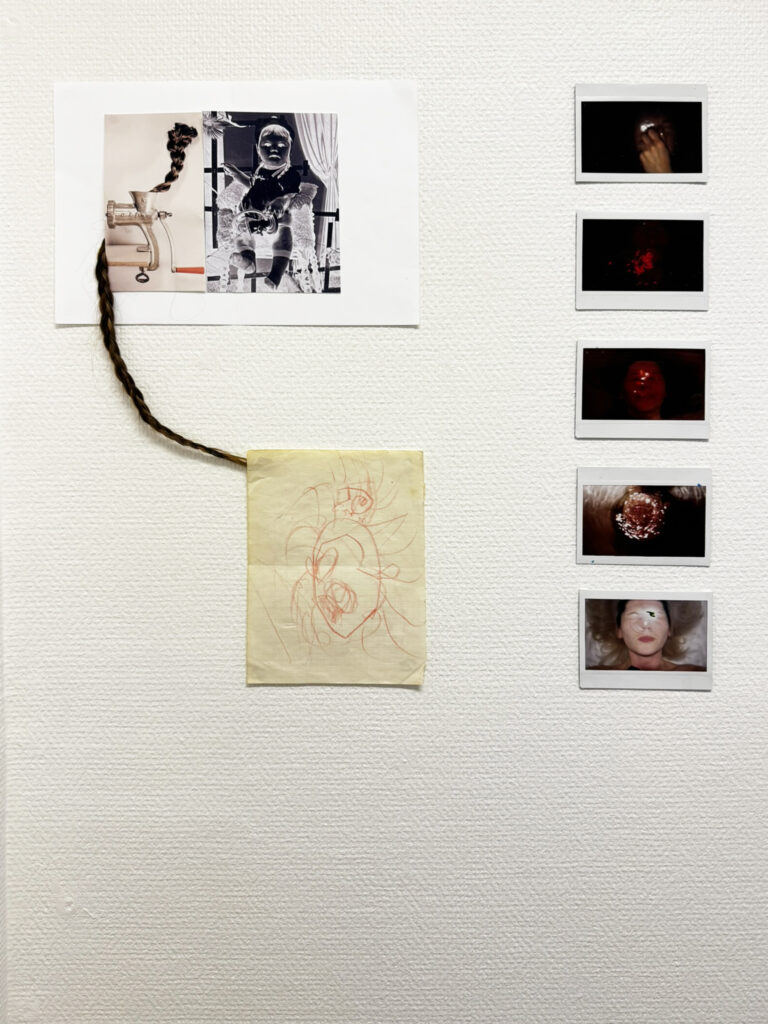
”Braid”, Installation; drawing (1985), photography, hair, 2015
When I was child, my hair grew for years, too long, reaching my waist, becoming a weight I carried without choice. My mother brushed it carefully, adding pink ribbons, beads, and clips, as if they completed an image I did not recognize as my own. When I was around seven years old, alone at home, I found my mother’s scissors hidden in the highest cupboard and climbed to reach them. Standing in front of the mirror, I cut my hair off without a plan, watching it fall to the floor and take with it the shape I had been forced to carry. It looked uneven and strange, but for the first time, the decision belonged entirely to me.

